Sunday, 26 January 2014

A very diverse cropping rotation

I arranged to visit John Evans who farms near Rakaia in Mid Canterbury. John had one of the most diverse cropping rotations I have seen, with between 10 and 13 different crops each year. The rotation includes corn salad, chrysanthemum, hybrid cabbage, hybrid mustard, linseed, red beet, spinach, radish, forage maize, feed and milling wheat, festulolium and brown top (grass seed). John's farm is also a test farm for Trimble, and therefore he utilises RTK guidance on his tractors and sectional control on his sprayer.
John Evans and Kye
 John has not used variable rate applications as he EM scanned one of his paddocks and did not see enough variability to justify the need. All the land is irrigated with a flat rate, but moisture sensors in each crop are used to assess the need and which crop is the most urgent. Dry years tend to lead to better crops as the right amount of water can be applied through irrigation and the soil is maintained as an aerobic medium.
When a new irrigation reservoir was built the surrounding earth banks were planted with native species as part of the "Trees for Bees" program, with a high number of vegetable seed crops grown it is important to encourage bees for pollination. A recent survey shown that only a small percentage of pollination was actually performed by bees, with the majority by other insects.
Native species planted around reservoir
 
 
A seed crop of hybrid cabbage, netted to protect it from birds, the males have been removed and the females left to be harvested. The seed is sold for $100/kg, and yields 300kg/ha to give a gross output of $30,000/ha less costs of $15,000/ha. 

Spinnach seed crop

Chrysanthemum seed crop
 
John's very varied rotation of crops also leads to the need to plant seeds in a variety of ways and row spacings. John has adapted a forklift side shift which he fits to the three point linkage of the tractor and is used to steer the drill independently to the tractor, using its own GPS receiver mounted on the drill.
Sideshift linkage on Drill
 
John also uses the sideshift linkage when inter row cultivating to increase the accuracy, and even though the tractor is using RTK guidance the cultivator moves side to side using its own RTK receiver. Sometimes he will use the drill on the front of the tractor to put down fertilizer between the rows and use the cultivator on the back to incorporate it.
 
Precision planter which is also used to place fertilizer


 Corn salad has to be planted in 75mm rows, but the drill interrow spacing is 150 mm, therefore the field is planted once then by using RTK guidance the original AB line is shifted by 75mm and planted again with the seed placed in between the original rows.
 
Drill used to plant the corn salad. High tech planting with old equipment!
 
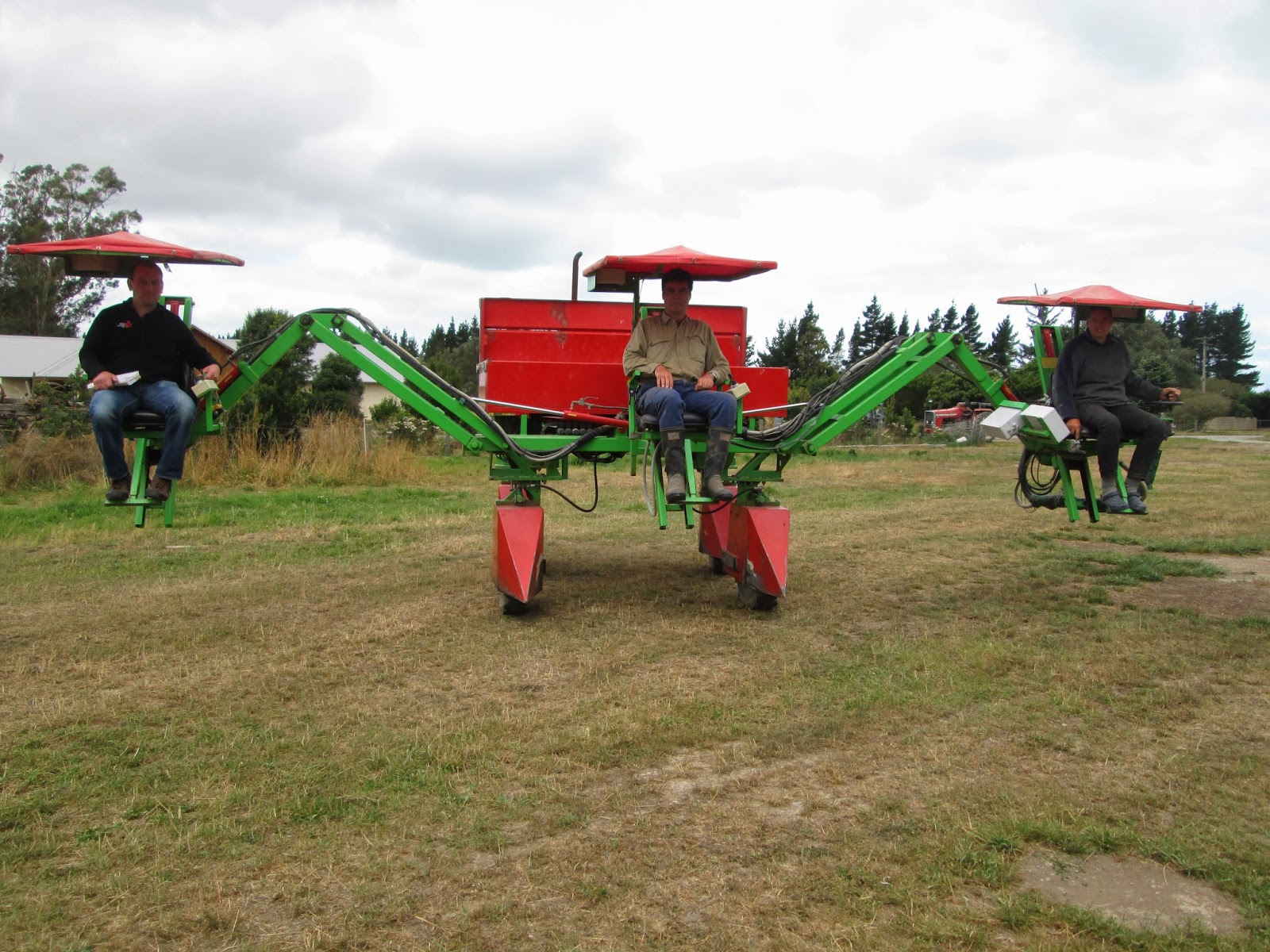
Kye runs a rouging business for local seed potato growers, she used a self propelled machine drive through the potatoes and carry three people who watch 4 rows each. Weed potatoes can be pulled up and carried on the machine to the edge of the field, increasing the area that it is possible to cover in a day.


Potato rouging machine
 

Saturday, 25 January 2014

A visit with Craige and Roz Mackenzie

After leaving FAR I headed to visit Craige and Roz Mackenzie who farm near Methven in Mid Canterbury. As I travelled out onto the Canterbury plain I was amazed by now much it had changed since I was last here 16 years ago. The rise of the dairy industry is incredible, with dairy farms and irrigators everywhere I looked. It is a clear indication of how NZ farmers adjust their farming practices to the markets and how adaptable the very productive the Canterbury plain is.

A dairy shed with centre pivot irrigator

 Craige and Roz Mackenzie run a diversified business including a 200 ha cropping farm, 360 ha dairy farm next door, a precision Ag company, Agrioptics New Zealand and Craige is also heavily involved with precision Ag in NZ and Australia.
 
The cropping farm grows a wide ranging rotation, which is common in NZ, including winter and spring wheat, grass seed, fescue, festulolium, carrots, chicory and radish. Most crops are grown for seed and will be contracted to meet market demand, as opposed to the global commodity crops we grow at home. The crops are all high value and managed accordingly, to a very high standard. The input costs are high but so are the returns.
A crop of seed Carrots
 
The carrots are a hybrid crop, with rows of males sown between the females, as was pollinating. At the end of pollination the males will be destroyed and only the females harvested for their seed.
 
A crop of Radish seed
 
Winter Wheat seed crop


All of the land has been EM (Electromagnetic) scanned, this involves measuring the electrical conductivity of the soil which can be used to indicate soil type, texture and stone content. The data is then processed using strict protocols to produce a soil map divided into management zones. The zones are then treated individually to manage the variability and target the potential of each zone. Base fertilizer is applied according to the yield potential of each zone and other inputs such as PGR (Plant growth regulators), fungicides and nitrogen can be applied variably if it is deemed necessary. None are varied in real time, instead a greenseeker fitted to the sprayer is used to scan the crop and measure the NDVI. This data is then interpreted in the office and used to produce a prescription map for a follow up application. The map is sent using WiFi to the controller in the tractor, via Trimble's "Connected Farm".
 
An irrigation water canal
 
 
The Canterbury plain is kris crossed with a network of irrigation canals extracting water from the large rivers flowing from the southern alps to the pacific ocean, to be used by agriculture. The landscape and the productive potential of the plain would be totally different if this water was not available. Craige has installed VRI (Variable Rate Irrigation) on all his irrigators, and is seeing a saving of 30% in his water usage as a result. VRI allows each management zone to be treated according to its need, through the use of moisture probes to record the moisture level at depth. Each zone is assessed weekly for the need to irrigate, with the aim to keep the zones between the refill point (moisture level when water is required) and the full point (moisture level when water starts to drain through the soil profile). Access to a very accurate weather forecast, Yes it does exist, is the final aspect in the decision of when and how much water should be applied.
 
Soil moisture probe
VRI of Spring Wheat
 
The irrigators can all be controlled and monitored from the office or Craige's mobile phone, maps are sent via WiFi to the irrigator. These maps can have areas which are not watered, such as laneways or water troughs in a pasture situation.

 
Plane applying fungicide to Chicory
 
#
Craig harvesting his most profitable commodity!
 
The dairy farm is not exempt from precision, each cow is feed an individual diet at milking according to the information held in its eartag. Milk temperature is measured and if any anomalies are found the cow will be drafted off after milking to be assessed by the herdsman. One of the biggest risks of nitrate leaching from a dairy unit is from the urine patches which are very highly concentrated with ammonia. Craige is working on a system called Smart-N, which identifies the urine patches and does not apply any extra Urea to those areas, using a greenseeker working in reverse. The greenseeker uses an optical sensor to locate greenness and then applies the required product. This technology will help to mitigate the leaching of nitrate from the soil and improve the environmental impact of the dairy industry which could be a problem in the future. 
 
Craige & Roz Mackenzie
 
 
I had a very enjoyable, informative and inspiring stay with Craige and Roz, and thank them very much for their hospitality in welcoming me into their home. It is fantastic to belong to the  Nuffield family. 


Tuesday, 21 January 2014

A visit to FAR

The first of my Nuffield visits in New Zealand was at FAR - Foundation for Arable Research, in Templeton. I was kindly hosted by Nick Pyke, CEO and Richard Chynoweth, Project Manager.
FAR is a levy funded research organisation, like the HGCA in the UK, but I was told that is where the similarities end! New Zealand is globally a small cereal producer, 1.2 Million tonnes,  is not self sufficient and considered a domestic market of Australia. New Zealand agricultural statistics can be found on NZ Ag Stats.

FAR represents around 2700 farmers, has regular contact with over 200 and will engage with approximately 500 farmers through its open days. The research is farmer lead and the results are delivered back to the farmer, FAR will involve and engage with other research organisations, industry partners and other knowledge resources to achieve the best skill set for a particular project. The involvement of FAR in the projects is to validate the research and make sure it is kept relevant to New Zealand agriculture, and is of value to New Zealand farmers as ultimately it is being funded by them.

Considering the very varied cropping rotations adopted, and the high number of crops under research the FAR team is small, but through collaboration with others they are able to cover their workload. The use of contractors at the trial sites also means that the researchers are able to concentrate on what they are good at and not have to sit on machines.
 
FAR have been utilising PA techniques in their research for several years and started with yield mapping, this lead to a huge amount of data and variability, from crop to crop and season to season, and was not considered a reliable source of data to make future management decisions. As the Canterbury region will have a rainfall deficit of 250mm during the growing season moisture management is key to crop production. This is clear to see by the amount of irrigation equipment now in use. This has lead to EM (Electromagnetic) scanning being a better starting point for gathering soil type and most importantly water holding capacity data, and 1cm of top soil will hold 1mm of available water as a rule of thumb. Water availability and management is key to maximising crop production in New Zealand. NDVI (normalised difference vegetative index) measurements are used to monitor and record the development of trials, and can be used as a check and balance on plots even if they don't get harvested for some reason, as has been seen that NDVI and Yield correlate closely.
 
They are also experimenting with the use of infra red temperature sensors to measure canopy temperature, and thermal imagery for weed mapping and pest damage.
 
We also discussed the topical issue of stubble burning, which is an active part of New Zealand arable farming, but was banned in the UK many years ago. There is a call for some form of stubble burning to be reintroduced in the UK to help combat the escalating blackgrass weed problem. Stubble burning is an important tool for many New Zealand farmers for several reasons, which are unique to their cropping rotation. The main difference between the UK and NZ| is the production of vegetable seed, such as carrots, Chicory, Plantain and Radish. These crops can't cope with lots of residue and competition, and as these are often the most profitable crops in a rotation they need to be established efficiently. Stubble burning also helps to destroy weed and volunteer seeds, which in turn reduces the reliance on subsequent herbicides, which I am certain UK farmers with a blackgrass problem would welcome. Another big benefit from stubble burning is the control of pest, like slugs, which are very prevalent due the high proportion of herbage crops in a rotation and the use of irrigation to maintain a moist soil profile. When you consider the problems associated with levels of  Metaldehyde in UK water courses, stubble burning help to reduce this environmental impact. To reintroduce stubble burning to the UK would have distinct benefits as previously outlined, but the main difference between NZ and UK, and was the main reason why the practice was banned originally, is the population density, and the fact that the UK is an urban country. It would be a very useful tool for UK arable farmers but would have to be used responsibly.

Sunday, 19 January 2014

The Next leg of my Nuffield adventure

It's time to get back on a plane and do some more travelling. This leg of my trip will take me to New Zealand, Australia and Brazil. New Zealand because it has a similar climate and crop growing conditions to the UK. Australia because farmers have to be innovative and manage extreme growing conditions, both lead to improvement in efficiency. My last destination will be Brazil, which is country I have wanted to visit for a long time. So the opportunity to have a look around with some fellow Nuffies was to good to miss. It will be interesting to see how Brazil is developing and how far off reaching its full potential it is? 
 
Thursday afternoon I left a wet and overcast Shropshire to get a train from Wolverhampton to London heathrow. My first flight took me as far as Abu Dhabi, landing in the middle of the dessert, total polar opposite to home.
 
Sunrise over the Gulf
Couple of hours later and its back on the plane bound for Sydney 14 hours later. We were an hour late getting to Sydney and hence had a tight turnaround to catch the last plane to Christchurch, New Zealand. So it was not surprising standing by the baggage carousel and no bag turning up. Just what you need after 36 hours of travel.

Thankfully I was staying with a friend and New Zealand Nuffie, Natasha King, so it was great to catch up with her and see a friendly face.

Natasha took me for a tour round the centre of Cristchurch, to see the damage from the earthquake nearly 3 years ago. The bumpy rounds were good to stop me going to sleep. It was like driving round a deserted city, and the damage was everywhere. A lot of the buildings that are still standing are empty and due to be demolished. Some buildings are being held up by walls of shipping containers. There is a new shopping mall where the majority of the shops are made from shipping containers, which has now become a popular tourist attraction, and has been created it an attractive manner.


A shipping container shop
 
The new shopping area

Some reconstruction work in Central Christchurch
 

Monday, 29 July 2013

Advanced Ag solutions with Daryl Starr

My second day in Indiana was spent with Daryl Starr the founder of Advanced Ag Solutions. Daryl started his company in 2006 after leaving the family farm. AAS now does soil sampling, scouting (crop walking) and has its software yield prediction tool, Optmzr, on 350,000 acres and across 27 States.

Daryl Starr
The optmzr software is a yield prediction tool used for Corn, which is the main crop in central Indiana. It can be used as a planning tool or an in crop decision making tool. It combines the variability of the major inputs of a corn crop, soil, seed, fertilizer and weather. Some of this data is known, such as soil type, seed characteristics, and up to date weather data,  and some such as  future weather is predicted. Optmzr amalgamates all the data across the different field zones and produces a yield prediction and also shows what is potentially the limiting factor for yield. This means that farmers and agronomists can quickly compare different management options. It also allows farmers to change management decisions for each zone from year to year, as even though soil zones are constant their year on year management is variable.
 
After lunch we visited some farmers that Daryl works with our first stop was Solid Rock Farms, near Remington where we met Mark Waibel, a young farmer fresh back from his honeymoon. Mark farms with his parents and uncle, 1000 acres which is 100% corn, alongside a Pig (Hog) enterprise. The Waibels are also involved with Precision Planting Ltd and install and service their products on other farmers planters.
 
Mark Waibel, Solid Rock Farms
 
Mark is using optmzr to help with the management of their corn crop, and it's making some recommendations that are different to the normal farm practice, and are being met with normal farmer cynicism. Optmzr is recommending applying more  nitrogen fertilizer in crop as a side dressing, as it was predicting a good yield response. Although it is not always practical to implement all these plans due to time and equipment restrictions, therefore most of the corn grown will have more than enough nitrogen applied pre and during planting to grow the crop. This is partly tradition but also helped by the price of corn and no real necessity to be totally efficient. This is in complete contrast to the efficiencies used on the planters, where they have single row sectional control and can vary the seed rate for each row unit according to a prescription map which is on an ipad in the tractor. Mark was trialling variable down pressure on the planter as it has been shown that there is a range of down pressure where you get good seed coverage but don't compact the soil below the seed, as soil conditions change.  
 
 
Automatic coulter down pressure control ram, which is varied according to a reading from a strain guage on the planter arm.
 
On the way to our next visit we passed a field of seed corn, where there is on row of male corn between every four rows of female corn. This field would have been established using a full tillage system, common for the area, and the soil looked lifeless but fortunately for the farmers is very forgiving and will still grow a very good crop of corn even if it is abused.


Seed corn crop, one male row between the females
.

We also visited Dan Desutter another of Daryl's clients, who farmed 4500 acres further south near Attica. The area changed from the very flat land of Remington, to a more rolling landscape.

Dan Desutter and I
 
Although the majority of Dan's land was cropped with corn he also grew some winter wheat, was totally no-till, used cover crops and had a herd of beef cattle that mob grazed his pasture. Dan was trying to harvest wheat when we arrived but the weather had a different idea. Dan grows wheat and cover crops after corn, because he truly believes that the land should be growing something all year round and capturing sunlight to pump carbon and eventually organic matter back into the soil. It also along with no-till reduces soil erosion on the slopes. Depending on planting date a different cover is used, early planted is a mixture of turnips, clover and annual ryegrass, with less turnips and clover planted as it gets later, then the last cover crops are either cereal rye or wheat. The following years corn crop will be planted directly into the cover crop, which may or may not have been sprayed off depending on workload. The corn has some starter fertilizer, normally 25lbs/ac of 10-34-0, at planting, which Dan says needs to be with the seed and not to the side and below, the placement of the fertilizer is critical to the corn getting away in the thick cover crop. This will then be followed by an application with the herbicide and a final application side dressed. Dan says that the combined effect of no-till and cover crop break down delays the mineralisation of the available nitrogen, and delaying the nitrogen side dress application matches the demand of the corn and leads to better yields, even though his corn may not look the best in the area in its early stages. As Dan was one of the first users of yield mapping, since 1993, he has copious amounts of data to substantiate his claims.

What is left of last years corn and cover crop residue
We ended the day with an excellent steak in a restaurant owned by a cousin of Dan's. It was a very enlightening day and I thank everyone who gave up there time to speak to me, and especially Daryl for organising the day.

Sunday, 14 July 2013

Back to School

My first day in Indana was spent at Purdue University, where I met Dr Bruce Erickson, Associate Driector, Centre for Commercial Agriculture. As I was going back to school I thought I would put my Nuffield Tie on. Thankfully it was a cooler day.
Purdue University
Cropping in Indiana is dominated by Corn and Soya Beans, and as is often the case farm size is increasing and labour forces are declining. These reasons are increasing the uptake of precision farming methods, now the majority of farms would be using guidance in some way and the benefits are easy to see and quantify. Whereas variable rate applications are less common, Bruce had done a study into precision farming uptake, and his findings substantiated these statements. Precision farming is seen by some of the larger farmers as an replacement of local knowledge, personally I think it is a tool to better utilise that local knowledge and not replace it.


We met up with Jess Lowenberg Deboer, Associate Dean and Director of International Programs In Agiculture (IPIA) for lunch. Jess had done a lot of studies into the economic benefits of precision farming, Historically Phosphate (P) and Potash (k) were not expensive, so variable applications were not used, but as prices have increased so has the uptake of variable rate. Variable rate application of lime is becoming increasingly popular as pH can be very variable within fields. The use of variable rate Nitrogen application is rare, primarily due to logistical constraints within timing and suitability of machinery, plus a reticence to change.

After lunch we met up with Larry Biehl,  Systems Manager, Purdue Terrestrial Observatory. Larry explained to me how much imagery data and soil data is available to US farmers for free on the internet, that has been collected over years by NASA and the federal government. As far as I am aware this kind of resource is not available to UK farmers, although some of the NASA data covers the UK. The USDA uses this imagery to monitor how crops are developing and mapping areas of drought or high moisture.

Next on the agenda was a tour of the new Nanotechnology department, which had cost $60M to build and was 50% funded by a private individual. Nanotechnology is studying materials on a very small scale 1 to 100nm (1 nm is 1 billionth of a M), this allows molecules to be manipulated and in fact substances behave in a different way on the nanoscale compared to the microscopic scale. One of the most incredible things is the clean room where the experiments take place, the amount of dust contamination is 10,000 times less than a normal operating theatre and all the air in the room is recycled several times a minute, for some reason we weren't allow inside!

Nanotechnology Clean Room


My final meeting was with Chris Johannsen and Marion "Baumy", Baugardner, which took place in the retirement home where Baumy lived. Both Chris and Baumy are retired directors of LARS, Laboratory of Applied Remote Sensing. Their combined knowledge of remote sensing and people involved with it was phenomenal. We discussed how remote sensing had been used to measure  a multitude of variables from crop residue levels, to hail damage and waterlogged areas to soil type.


Thursday, 11 July 2013

Space and Rocket centre

A day off from Nuffield visits today and some time to fill before my flight back to Chicago. The US space and rocket centre was just up the road in Huntsville so I decided to have a look around. It was a busy place with lots of school children taking part in space camp learning all about space and astronauts.

 
There were all different rockets on display from small ones to the very large. It was strange visiting a place like this with out my family as I sure they would have really enjoyed it.


The space shuttle that astronauts used to train on was on display, it is amazing how big it is and what a feat of engineering it was to get it into the earths orbit and bring it back to land. Especially when you consider how small a part of a rocket actually makes it back to earth after the launch.


Saturn V Rocket
The Saturn V rocket was used for the Apollo missions that eventually lead to man landing on the moon. There is another replica of the Saturn V rocket inside the centre but it is displayed in sections so you can see how it breaks apart during its launch.
 

The capsules that the astronauts were in during the launch were tiny in comparison to the rockets that propelled them into space.
Lunar Module
It was impressive to see a replica of the lunar landing Module. I am not sure what I would have thought if the NASA engineers had showed me the lunar Landing Module and told me that this machine would be able to land on the moon and then launch again to return to the landing capsule.
 
This time my flight to Chicago went without a hitch and my bag followed me all the way to my next hotel in Indiana.